Florida State University Legacy Walk

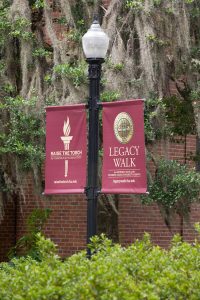
Florida State University has been paving the way since 1851. In October 2004, the university unveiled the first of four phases of Legacy Walk, a historical tour of campus that focuses on its architecture, sculpture and green spaces. The first segment of the Walk, the Eppes Phase, is named for the founder of the University, Francis Eppes. Encompassing the easternmost portion of campus, the Walk begins at the Eppes statue located near the entrance to the Westcott Building. The path is embedded with symbols and lined with bricks and banners guiding visitors past many of the oldest and most historic buildings on campus before terminating at Dodd Hall. Raised brick podia containing maps and important information about people and events are located at intervals along the walk.

The second phase, the Student Legacy Walk, begins at the Landis Green Legacy Fountain Sculptures. As the name suggests, the Student Legacy Walk passes through the core of student activity, highlighting student leaders of the past and serving as a living legacy to current and future students. Lined with banners depicting campus life, the Student Legacy Walk guides visitors from Landis Green north toward the Bellamy Building, around to newly renovated grounds behind the Crenshaw Building and Moore Auditorium, and circles the Integration Statue before wrapping around the Student Services Building and ending back at Landis.

For more information on the FSU Legacy Walk, contact the Office of University Relations at 850.644.1000.

Phase 1 – Heritage Walk

From Westcott Plaza – Covers the most historical section of campus

1.

Westcott Building, Gate and Fountain

Constructed in 1910 as the Administration Building for the Florida State College for Women, the Westcott Building continues to house the university’s central administrative offices, including those for the president and provost, as well as a 1,200-seat concert hall named for Ruby Diamond, a 1905 Florida State College alumna and benefactor.

With its two five-story octagonal towers framing the main entrance, the Westcott Building is the architectural centerpiece of the Florida State University campus. The building was named in 1936 for former Supreme Court Justice James D. Westcott, Jr., who bequeathed his entire estate to West Florida Seminary in 1887.

In 1969, much of the Westcott interior was destroyed by fire, although the architectural integrity of its exterior was retained. Ruby Diamond Auditorium, meanwhile, was renovated in 2010 and rechristened Ruby Diamond Concert Hall. The renovation also enlarged the Westcott lobby and backstage amenities, and included the addition of a large rehearsal space. Today this 1,172-seat performance space with state-of-the-art production systems is considered a Tallahassee cultural icon.

The original fountain was a gift of the Florida State College for Women classes of 1915 and 1917 and graced the campus’s main entrance for more than 70 years. It was renovated in 1982 in remembrance of philosophy professor Anna Forbes Liddell and in 1988 was replaced with an exact replica when the original support structure began to fail. The Westcott Gate serves as the main entrance to campus and was a gift of the classes of 1916 and 1918. The Westcott Building, gate and fountain, sometimes referred to as Westcott Plaza, have become iconic symbols of the university.

The commemorative brick plaza that surrounds the fountain originated as a project of the classes of 1996 and 1997 and was constructed in 1998. The statue of Thomas Kent “TK” Wetherell commemorates the first graduate of Florida State to become the university’s president (2003-2010).

State Historical Marker

The Florida State University Campus is the oldest continuously used site of higher education in the state of Florida. In 1851, the Florida Legislature authorized the establishment of two state seminaries, one east and one west of the Suwannee River. Eager to attract the western seminary, the city of Tallahassee, under the leadership of Intendent (Mayor) Francis Eppes, offered to donate four city lots on which to locate the school and provide $2,000 a year for its operation. The site chosen for the new institution was the crest of “Gallows Hill,” located about a half mile west of the center of town. The West Florida Seminary opened in 1857, the first classes being held in a wood frame building erected by the city. Eppes, the grandson of Thomas Jefferson, served for eight years as president of the seminary’s governing board. In 1901, the name of the school was changed to Florida State College, in 1905 Florida Female College, and in 1909 it became The Florida State College for Women. The Florida Legislature transformed the college into a fully coeducational institution in 1947, creating The Florida State University.

Fountain Marker

The Westcott Fountain and Plaza

Since 1917, the Westcott Fountain has been a symbolic landmark of the rich heritage and traditions of the Florida State University and its predecessor institution, The Florida State College for women.

A gift of the classes of 1915 and 1917, the original fountain graced the main entrance to the campus for over seventy years. It was renovated in 1982 in remembrance of professor Anna Forbes Liddell (1891-1979), Robert O. Lawton Distinguished Professor of Philosopy. In the summer of 1988, when the supporting structure began to fail, the historic fountain was replaced with an exact replica.

The commemorative brick plaza that surrounds the fountain originated as a project of the classes of 1996 and 1997. It was constructed during the winter and spring of 1998 through donations from alumni, students, faculty, staff, and friends of the university.

2.

Francis Eppes Statue

Francis Eppes VII, a grandson of Thomas Jefferson, was central to the founding of the Seminary West of the Suwannee, a forerunner to FSU. The seminary was located on the site of the present Westcott Plaza and fountain, making this location the oldest continuous site of higher education in Florida

Eppes moved to Tallahassee from Virginia in 1829 and took an active role in local affairs. After serving as a Justice of the Peace and then Intendant (Mayor) of Tallahassee, Eppes shifted his focus to educational issues.

The General Assembly of the Florida Legislature enacted a bill on January 24, 1851, that established two seminaries of learning in the state, one to the east and one to the west of the Suwannee River. When it was announced that the two Florida cities offering the best facilities would each be awarded an institution, Eppes set out to ensure that Tallahassee would be one of them.

In 1857, the Florida Institute, previously established in 1854 as a school for boys, began operating as the Seminary West of the Suwannee. Eppes served on the seminary's Board of Education for 11 years, the last eight as president. The life-size bronze statue of Eppes was created by Tallahassee artist and Florida State University alumnus Edward Jonas and installed in 2003.

Pyramid Marker

50th Anniversary of Integration – April 19, 2012

Starting at the Integration Statue, this disk passed hand to hand along a human chain of hundreds and was set into this pyramid to symbolize the broad reach of diversity across campus.

3.

Mina Jo Powell Alumni Green

Named in honor of distinguished alumna and university supporter Mina Jo Powell, the green has hosted student gatherings since the 1930s, as well as graduation ceremonies for more than five decades. On the edge of the green stands a statue of George Edgar, first president of the Seminary West of the Suwannee (1887-1892). At the north end, an inscribed granite and slate memorial reveres students who passed away while attending FSU.

Mina Jo Powell was a class of 1950 Florida State College for Women/Florida State University graduate and the first woman to serve on the Board of Directors for the Seminole Boosters (1974-1984). The green space was named for her in 1990, in honor of her lifelong service and generosity to Florida State University.

Surrounding the granite/slate memorial is a garden and water feature; this contemplative space with seating was a gift from the class of 2012. The 50-ton memorial was commissioned by the Student Government Association (SGA) and incorporates black Virginia slate with black granite quarried in Africa. The inscription was selected by the SGA. The green’s Gothic benches were fashioned at the university’s Master Craftsman Studio.

Colonel George M. Edgar was the first appointed president of the West Florida Seminary on August 15, 1887, after a successful military and academic career. A Virginia native, Edgar, during his five years as president, added to its buildings and raised the course of study. Known as a man of patience and vision, Edgar guided the Seminary from its small beginnings, and was also popular with students, who considered him a wise mentor and loyal friend. The establishment of a four-year curriculum put the school on a par with its southern counterparts, and Edgar’s appointment proved to be a turning point in the history of the institution and its strong liberal arts tradition.

Kiosk

Mina Jo Powell Alumni Green

A campus gathering place for more than a century and site for commencement for nearly five decades, this green was dedicated in 1990 to Mina Jo Powell (B.S., 1950, M.S., 1963). Powell, a member of the final class to graduate on the site, was lifelong contributor to the university and a relentless advocate for green open spaces on campus. The green offers a restful place to enjoy sunny hours of learning and friendship.

A statue of George Matthews Edgar stands nearby. A Confederate colonel who had been a professor of natural science here before the Civil War, Edgar was the first to hold the title of president of the Seminary West of the Suwannee. Edgar’s tenure as president from 1887-92 marked the beginning of this institution’s strong liberal-arts tradition. In 1891, the school awarded its first bachelor of arts degrees to seven students.

4.

Rowena Longmire Student Alumni Building

Constructed in 1938, the Longmire Building is named in honor of English professor and founder of the Florida State College for Women Alumnnae Association, Rowena Longmire. Although renovated, the building retains its architectural integrity.

The Longmire Building originally housed the offices for the Alumnae Association, Student Government Association, YWCA, and campus publications, as well as the student lounge and locker room for day students. On the third floor were accommodations for visiting alumnae and distinguished guests. Longmire was the first building to be named for a faculty member and through the years housed a soda shop, music library and law library. Today, the lobby and first-floor offices maintain their original oak paneling and the lounges their hand-painted plaster ceilings and Gothic décor. It serves as the administrative home of the College of Arts and Sciences, the oldest college at the university.

5.

Sandels Building, Jennie Murphree Hall, Cawthon Hall

The College of Human Sciences occupies the Sandels Building and the statue of former president Albert Murphree faces the Jennie Murphree residence hall, which was constructed in 1922 and enlarged two years later to accommodate the growing student population. Cawthon Hall was built in 1946 and today houses Living & Learning Communities for music students and Women in Science, Math and Engineering (WIMSE).

Constructed in 1956, the Sandels Building was named in honor of the former Dean of Home Economics, Margaret R. Sandels (1922-1958), and represented the complete transition from the Gothic architectural style of the Florida State College for Women to the modern design of the Florida State University. In the early 2000s, Sandels underwent extensive renovations, which also integrated its eastern façade to the Collegiate Gothic design of the older residence halls.

Jennie Murphree Hall was named in honor of the wife of the first president of Florida State College for Women, Albert Alexander Murphree, after she unexpectedly died in 1921. Murphree also served as president from 1897 to 1909 of the other forerunners to Florida State University: The Seminary West of the Suwannee, Florida State College, and Florida Female College. In 1992, Jennie Murphree Hall underwent a major renovation.

Cawthon Hall was named for Sarah L. “Tissie” Cawthon, the first Dean of the College Home (1910-1925), which is now called Student Affairs, and would be the last FSCW structure on campus to conform to the original Collegiate Gothic design. The building contractor followed the original specifications that called for a stone relief of “FSCW” to be placed at one entrance, even though the building was not completed until 1949, one year after the college became coeducational, and its name changed to Florida State University.

6.

Strozier Library, Landis Green, William Johnston Building

Strozier Library serves as the main campus library with seating for more than 2,600 users. Landis Green is a popular student-recreation space and its fountain commemorates the university’s transition from past to present. A 2011 renovation of the Johnston Building maintained the structure’s historic exterior but thoroughly modernized its interior.

The three-story library opened in 1956, replacing the old library in what today is Dodd Hall. After the sudden death of FSU president Robert Manning Strozier, the new library was named in his honor in 1961. The five-story annex at the rear of the building was added in 1967.

The Lawton Professor obelisk in front of the library lists Florida State University professors who have received the highest honor faculty members bestow upon their colleagues. The Love Heirloom oak tree is more than 200 years old, and the area around the library was at one time the site of the produce and livestock farm for the Florida State College for Women.

The six bronze sculptures in the fountain on Landis Green depict students throughout the history of the university; they are the work of Tallahassee artist and FSU alumnus Edward Jonas. Landis Green also includes a marble tablet commemorating the Omicron Delta Kappa honor society and a fabled “kissing bench.”

The William Johnston Building is a Gothic Revival structure decorated with symbols depicting its original function as a dining hall. The building’s renovation included restoration of the dining areas’ original vaulted ceilings in what is now classroom space. The ground floor houses resources for students including advisors, tutors and success coaches.

7.

Gilchrist Hall, South Gate, and The Greek Park

The east wing of Gilchrist dormitory was built in 1926 and its south and west wings were added in 1928. The South Gate, the university’s distinctive southern entrance was designed and built in 1933. The 15-foot, multiple-patina bronze statue in The Greek Park was a gift from the Chi Omega sorority.

Gilchrist Hall was named for Florida Governor Albert W. Gilchrist (1909-1913), a staunch supporter of the Florida State College for Women. At its completion, Gilchrist Hall was the most contemporary dormitory on the campus, with two lights, electrical outlets, and extra-long beds in each room. All of the Florida State College for Women dormitories were connected by a series of arcades, and in 1939, when Landis Hall was completed, a three story connector linked it to Gilchrist.

When the South Gate, a gift of the classes of 1933 and 1935, main gate (Westcott) and two similar gates along the north side of the campus – which were later removed – were closed, motorized traffic was barred from the Florida State College for Women campus.

The “Three Sisters” statue was presented to the university as a catalyst for renovating and beautifying the historically significant Greek Park green space, and to encourage other fraternities and sororities to enhance the park with their own projects. Alpha Delta Pi sorority commissioned the university’s Master Craftsman Studio to create the Greek Park gazebo, which is outfitted with stained glass that depicts Alpha Delta Pi symbols.

8.

Broward Hall, Bryan Hall

Bryan Hall, constructed in 1907, is the oldest existing campus building and was named for William James Bryan, a U.S. Senator from Jacksonville. Broward Hall was named for Florida Governor Napoleon Bonaparte Broward (1905-1909) and built in 1917.

After a wood-frame dormitory was destroyed by fire in 1906, the state legislature approved the funding of Bryan Hall, which consisted of 40 two-bedroom suites connected by studies, accommodating 160 students. After its construction, Bryan Hall quickly became the social center of the Florida Female College campus. The sundial in front was a gift from the class of 1921.

Broward Hall, with the distinctive crenellated parapets that it shares with Bryan Hall, opened for use as a dormitory for the students at the Florida State College for Women in 1918. The arcade connecting Bryan and Broward was completed in 1922.

Sundial Plaque

With the outbreak of World War One in 1917, the entire student body of the Florida State College for Women gathered around the flagpole on the front lawn of Bryan Hall. Here they sang the national anthem as they reverently lowered the flag and the graduating class of 1921 presented this sundial to Bryan Hall.

This piece was restored and reset here in the spring of 2011 by the Florida State University Grounds and Landscape Operations Department.

9.

Dodd Hall, Heritage Museum, Werkmeister Window

The most elaborate example of Collegiate Gothic architecture on the FSU campus is Dodd Hall. The inscription over its main entrance is rendered in gold leaf and was coined by a brick mason during the building’s construction. The university’s Heritage Museum is free and open to the public on weekdays during normal business hours. The stained glass window at the far end of the museum depicts the university’s four best-known buildings.

Dodd Hall served as the Florida State College for Women/Florida State University Library from 1923 to 1956. The museum occupies the Werkmeister Humanities Reading Room in the oldest part of Dodd Hall. Its signature stained glass window – 22-feet tall by 10-feet wide and consisting of more than 10,000 glass pieces – was designed by professor emeritus Ivan Johnson and created by FSU alumni Bob and Jo Ann Bischoff.

Dodd Hall was renovated in 1991 and again in 2010 but retains its interior and exterior architectural integrity. The large oil painting in the lobby depicts the university’s history; it was commissioned by the class of 1949 and painted by renowned artist and FSU alumnus Artemis Jegart Housewright. The smaller west wing was built in 1925 and the larger east and south wings were constructed between 1928 and 1929. Home to the library until Strozier Library opened in 1956, Dodd Hall was named in honor of William George Dodd, a former English professor and Dean of the College of Arts and Sciences from 1910 to 1944.

10.

Williams Building, Diffenbaugh Building

The Williams Building today houses the English department and the 189-seat Augusta Conradi Studio Theater. A statue of Augusta’s husband, Edward Conradi, president from 1909-1941, is located between the Williams and Conradi buildings. The Diffenbaugh Building is on the same site as the original Science Hall, which was built in 1922.

When it was constructed in 1927, the Williams Building was the third classroom building at the Florida State College for Women, and home to the Industrial Arts (predecessor to Home Economics) and Commerce Departments. In 1931, an addition doubled the size of the structure, and in 1946 more offices and classrooms were added. Officially named Social Sciences Hall but more commonly referred to as the History Building, the Williams Building was named in 1946 in honor of history professor, Arthur “Pi” Williams.

Science Hall was the second classroom building constructed at the Florida State College for Women. Together with the Administration (Westcott) Building and Education (Eppes) Building, it formed the academic entrance to the college. When the front section of Science Hall was demolished in the 1970s, its Gothic entrance and other decorative features were incorporated into the main façade of the new building, Diffenbaugh. Portions of the original are still in place on the Jefferson Street side, including gable walls, windows and dormers. The building was named doe Guy Diffenbaugh, English professor and one time Dean of the College of Arts and Sciences.

Statue Podium

Thomas Kent “T.K.” Wetherell

President: January 6, 2003 – January 31, 2010

During the tenue of T.K. Wetherell The Florida State University enrolled the most academically talented students in the history of the university, increased the number of doctoral degrees awarded, set new records for research dollars and experienced a boom in campus construction.

Under Wetherell’s leadership, students reached unprecedented national academic recognition, including three Rhodes Scholars.

A career educator who served in the Florida House of Representatives from 1980-92, including two years as Speaker, Wetherell earned his bachelor’s and master’s degrees as well as a doctorate in education administration from Florida State. He served as president of Tallahassee Community College from 1995 until 2001.

Wetherell attended Florida State University on a football scholarship and played on the 1963-67 football teams. On his retirement from the presidency, Wetherell became a tenured professor in the College of Education and President Emeritus.

Statue Plaque

We, the brothers of Phi Delta Theta, dedicate this statue to our brother, Florida State alumnus and 13th president of the Florida State University, Dr. T.K. Wetherell. His outstanding leadership, vision, service and commitment to excellence stand as an example to our community and brotherhood.

Historic Symbols and Seals at the Westcott Flag Court

In 1851, the Florida Legislature established the State Seminary West of the Suwannee River. The owl was selected as its symbol to represent wisdom, one of the main ideals of the new coeducational institution.

In 1901, the Seminary West of the Suwannee became Florida State College. Two torches were added to the owl to shed light on knowledge. The date was added to represent the year that the first Florida institute of higher learning was chartered. This was the first official seal of the institution.

From 1905 to 1909, Florida State College was known as Florida Female College. The name was later changed to the Florida State College for Women. The owl was replaced by a third torch, and a banner that reads, “Vires, Artes, Mores” was also added. This was a complete statement of the institution’s purpose: to educate women physically, mentally, and morally and in so doing produce Femina Perfecta, the completed woman.

In 1947, Florida State University was established by an act of the legislature. The three torches on the seal symbolize the University’s purpose: the passing of knowledge from generation to generation. The torch on the left is Vires: strength of all kinds, physical, moral, and intellectual. The center torch is Artes: that with which we acquire knowledge that transcends skills and the appreciation of beauty. The torch on the right is Mores: customs, character and tradition. Through these three ideals the student is educated physically, mentally and morally.

The Senior Class of 2000 made the presentation of these historical seals possible.